Chapter 1 · 1819—2025
Overview
One name, several businesses, and two stories that must not be confused.
A history of engineering
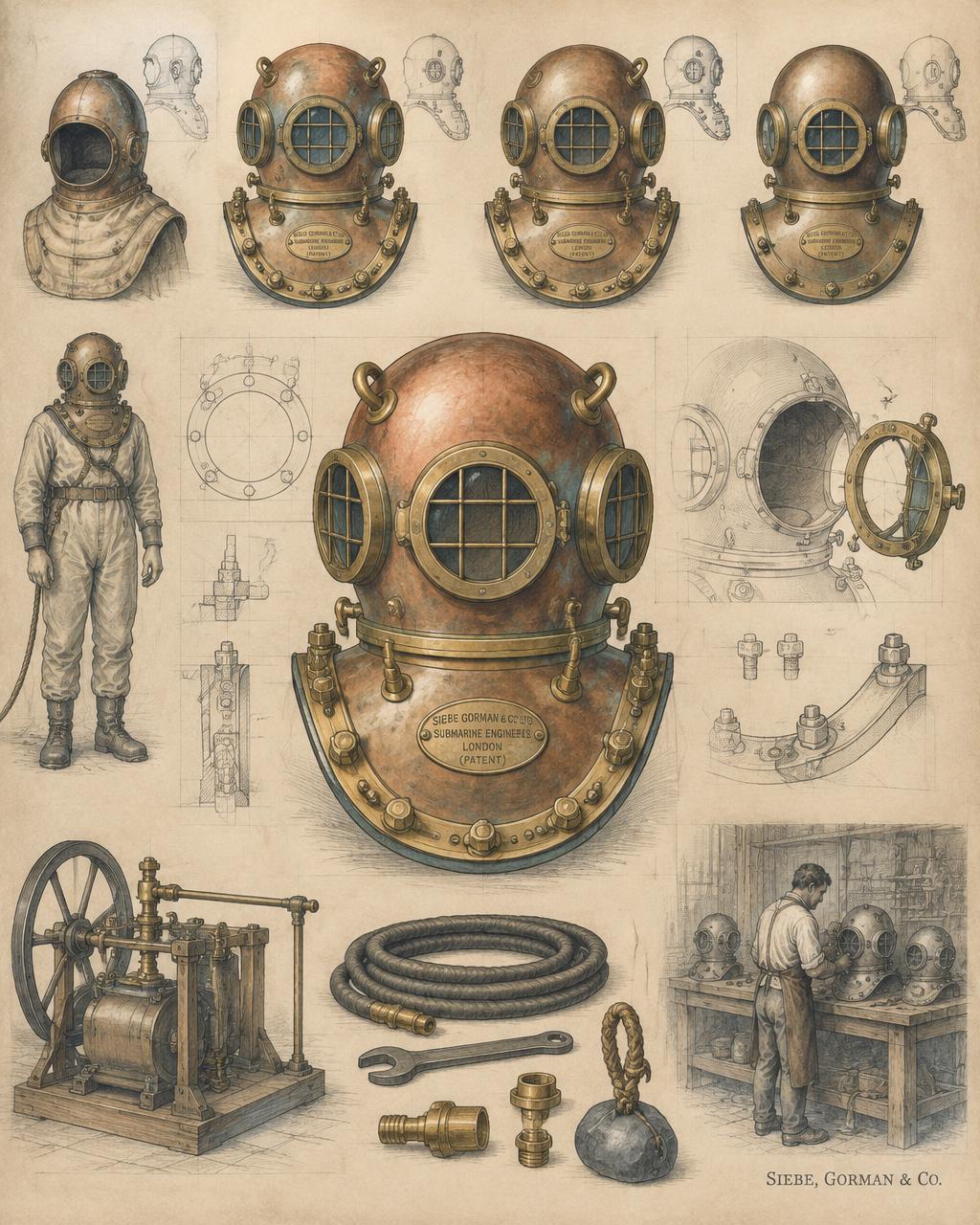
The historic story begins with Augustus Siebe’s London engineering workshop and follows the development of practical diving dress, surface-supplied equipment, breathing apparatus and, much later, recreational scuba. These technologies helped people work below the surface, escape from submarines and enter the water for sport.
The name passed through partnerships, incorporation, mergers and sales. These changes shaped the historic record.
The present day
Siebe, Gorman & Co Ltd was incorporated on 11 August 2025 and focuses on recreational diving equipment.
At a glance
| Period | Name | What it represents | Historical context |
|---|---|---|---|
| c. 1819–1868 | Augustus Siebe / Siebe & Co | Precision engineering and early diving apparatus | Historic business |
| 1870–1904 | Siebe & Gorman | Submarine engineering and diving equipment | Historic business |
| 1904–late 20th c. | Siebe Gorman & Co Ltd | Diving and breathing apparatus; later industrial group | Historic business |
| Late 20th c.–2019 | Later ownership and related names | Successive sales, renamed operations and dissolution | Later ownership |
| 2025–present | Siebe, Gorman & Co Ltd (16643174) | Modern recreational diving equipment manufacture | A separate new company |
Helmet design chronology
From open helmet to standard dress
Four documented stages place the illustrated helmets in time. Dates describe a design milestone or a surviving example; they do not imply that every variant appeared in one year.
1820s
Deane open smoke / diving helmet
An open copper helmet supplied by hose and worn with a short jacket. The Science Museum attributes its example to Augustus Siebe and describes Deane use as probable.
Dating evidence
Museum object dated 1820–1829
Open collection record1 / 41839
Closed helmet and breastplate
The watertight dress was secured to the breastplate. The museum record credits Augustus Siebe as patentee and John Deane as designer, based on an earlier George Edwards design.
Dating evidence
Science Museum object 1881-47, dated 1839
Open collection record2 / 419th c.–20th c.
Twelve-bolt standard-dress helmet
The twelve-bolt fastening became a long-running commercial and Admiralty-pattern form. The linked helmet is one surviving Siebe Gorman example, not the date of the design’s first appearance.
Dating evidence
Queensland example dated c. 1905–1908
Open collection record3 / 4c. 1900–1905
Six-bolt Admiralty helmet
Associated with Robert H. Davis and intended to speed naval dressing. Its appearance in the 1905 company catalogue supports an introduction around the turn of the century.
Dating evidence
Surviving RMG example; 1905 catalogue evidence
Open collection record4 / 4