
Photographs
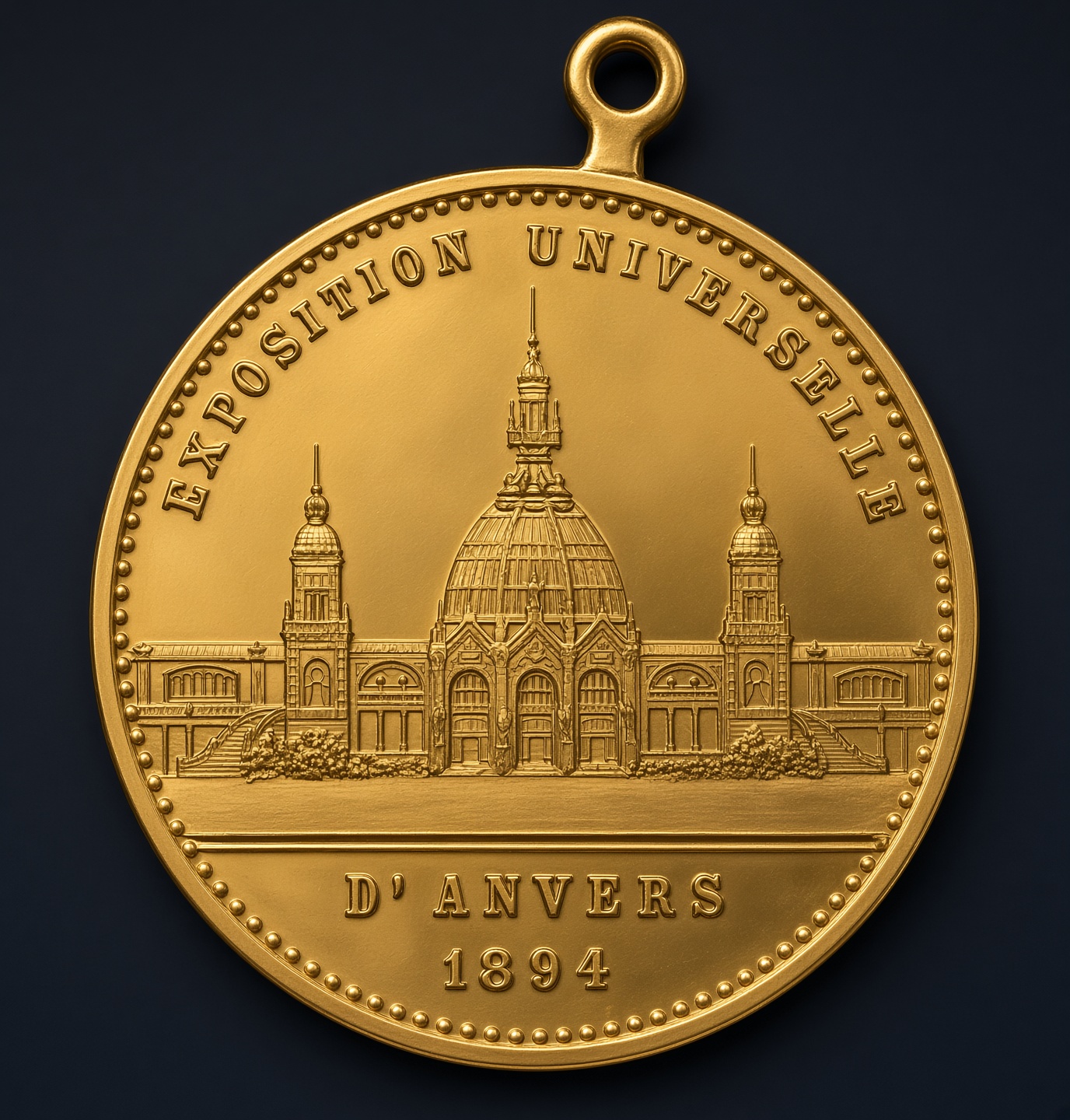

Details
- Occasion
- Exposition Universelle / Wereldtentoonstelling, Antwerp, 1894.
- Designer
- Official larger medals by Jules Baetes; smaller gilt souvenirs of the palaces (as photographed) circulated widely.
- Metal & type
- Gilt bronze souvenir / award medal with suspension loop.
- Historic connection
- Science Museum notes that the company “exhibited diving apparatus at the Antwerp Exhibition” in 1894. Antwerp also appears on the firm’s own medal list.
The reverse shows the Scheldt, the city and the exhibition date. Larger official awards by Jules Baetes also show the portrait of Leopold II.
Later catalogues add gold and silver medals from the Inventions Exhibition (1885), the Colonial & Indian Exhibition (1886), Paris 1889 (gold), Paris 1900, the Military Exhibition of 1901 and Cape Town, together with Chelsea’s Royal Naval Exhibition of 1891 — a continuous presence on the exhibition circuit from Augustus Siebe’s 1851 prizes to the Edwardian years.
View in the History archiveSources
Medal-related sources from the shared bibliography. They document exhibitions and attributions in general; no single source proves the provenance of the pictured example.
- Official Descriptive and Illustrated Catalogue of the Great Exhibition, 1851 — Augustus Siebe, Class V and Class VII entries.
Contemporary exhibitor listing for Siebe’s diving apparatus. It establishes exhibits, but does not by itself prove the ownership or provenance of any medal pictured here.
- Science Museum Group Collection. “Augustus Siebe” (person record cp48664).
Institutional biography covering the workshop, Deane collaboration, 1851 exhibition, family succession and Siebe’s death in 1872.
- Burchett, Michael, and Robert Burchett. “An Updated Short History of the British Diving Apparatus Manufacturers, Part 1: The Siebe Gorman Company.” The International Journal of Diving History.
Historical Diving Society study used for the manufacturer’s personnel and company chronology; it is not treated as proof for every medal attribution.
- Blaxland, Gregory. “Wine from New South Wales.” Transactions of the Society Instituted at London, vol. 46, 1827.
Digitised primary publication of Blaxland’s account of New South Wales wine in the Society’s Transactions. It documents the award history behind his 1823 silver medal; this is not Augustus Siebe’s separate Vulcan Medal of the same year.
- Royal Museums Greenwich, Denny Collection. Exhibition prize-medal records MED2789, MED2787, MED2795 and MED2797.
Museum records for London 1862, Vienna 1873, Sydney 1879 and Edinburgh 1890, supporting dates, materials, inscriptions and medallist attributions.
- Victoria and Albert Museum. “Prize medal, 1862 London International Exhibition,” Leonard Charles Wyon (O311815).
Catalogue record for the 1862 London prize-medal design, iconography and inscription.
- Germanisches Nationalmuseum. “Wien, Weltausstellung, Preismedaille ‘Dem Verdienste’ 1873” (Med13897).
Museum record for the Vienna medal by Josef Tautenhayn and Karl Schwenzer; it also cites Augustin’s specialist catalogue.
- Smithsonian National Museum of American History. “Centennial International Exhibition of 1876 Award Medal.”
Institutional record for Henry Mitchell’s Philadelphia Centennial award medal, including its legend and issue context.
- Powerhouse Collection. “International Fisheries Exhibition medal and case, 1883” (N18088).
Confirms Leonard Charles Wyon’s obverse, Lewis Foreman Day’s reverse and manufacture by John Pinches.
- The Metropolitan Museum of Art. “To Commemorate the Paris International Exposition of 1878,” Jules-Clément Chaplain.
Museum catalogue record supporting the Chaplain attribution for the Paris 1878 medal type.
- Augustin, Ines. Die Medaillen und Plaketten der großen Weltausstellungen 1851–1904. Vienna, 1985.
Specialist reference covering the world’s-fair medal series across the central period of this archive; linked through the Germanisches Nationalmuseum catalogue citation.
- Forrer, Leonard. Biographical Dictionary of Medallists, Coin-, Gem-, and Seal-Engravers. 8 vols. London, 1904–1930.
Standard biographical reference for medallists, used here especially for Lewis F. Day and exhibition-medal designer credits.