
Beginning marine life identification
Learning to identify fish and invertebrates adds a new dimension to every dive. Recognizing families and behaviors helps you understand the health of the reef ecosystem.
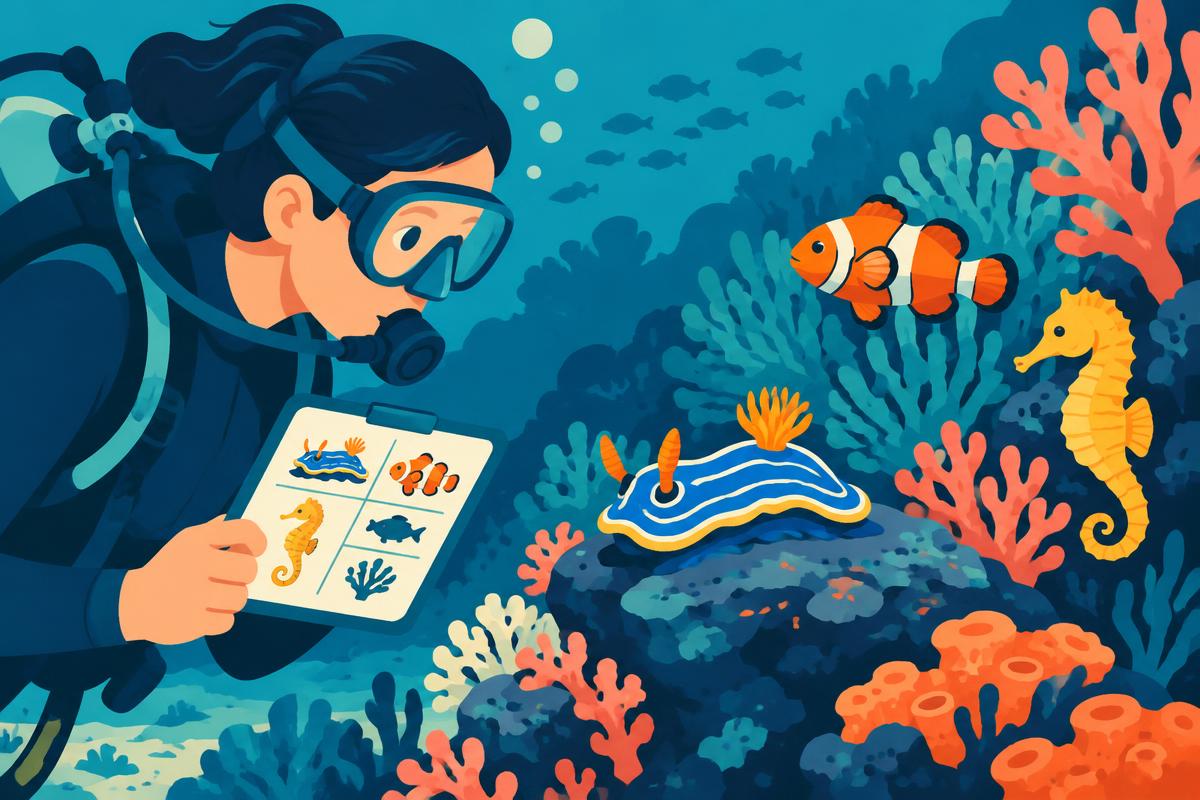
Observe without disturbing
Never touch, chase, or harass marine life to get a better look. Keep a respectful distance to avoid causing stress to animals or damaging the fragile reef structure.
Start with families
Rather than trying to memorize every species, start by learning to recognize major families like parrotfish, groupers, or nudibranchs. Look for distinctive body shapes, swimming styles, and mouth positions.
Pay attention to the habitat where you find a creature. Some species prefer sandy bottoms, while others are always found near specific types of coral or in crevices within the reef wall.
Using identification tools
Underwater slates and waterproof ID cards are excellent tools for real-time identification. They allow you to compare what you see directly with illustrations while the memory is still fresh.
After the dive, consult comprehensive regional guidebooks or digital databases. Recording your sightings in a dive log helps reinforce your knowledge and track your progress as a citizen scientist.
Observing behaviors
Identifying an animal is only the beginning; observing its behavior provides deeper insight. Look for signs of cleaning stations, territorial displays, or unique feeding methods among different species.
Quiet and still observation often reveals creatures that were previously hidden. By moving slowly and controlling your buoyancy, you become less intimidating and can witness natural interactions.
Dive-day checklist
Identification tips
- Learn the characteristics of major fish families
- Note the body shape and color patterns
- Observe the animal’s habitat and depth
- Use an underwater ID slate for reference
- Log your sightings to build your knowledge
General guidance only. Follow your training, the dive operator’s procedures, and each manufacturer’s current instructions.
Ask the dive guide
Personal guidance for your next dive
Describe a dive scenario or an equipment-care question. The guide answers in your language and points you to relevant journal articles.
General educational guidance only. It is not medical advice, emergency instruction or a replacement for training, certification, manufacturer instructions, your operator's briefing or your dive plan.