
The pre-dive weighting check
Carrying the correct amount of lead is fundamental to good buoyancy. A proper weight check ensures you are neither overweighted nor struggling to stay down.
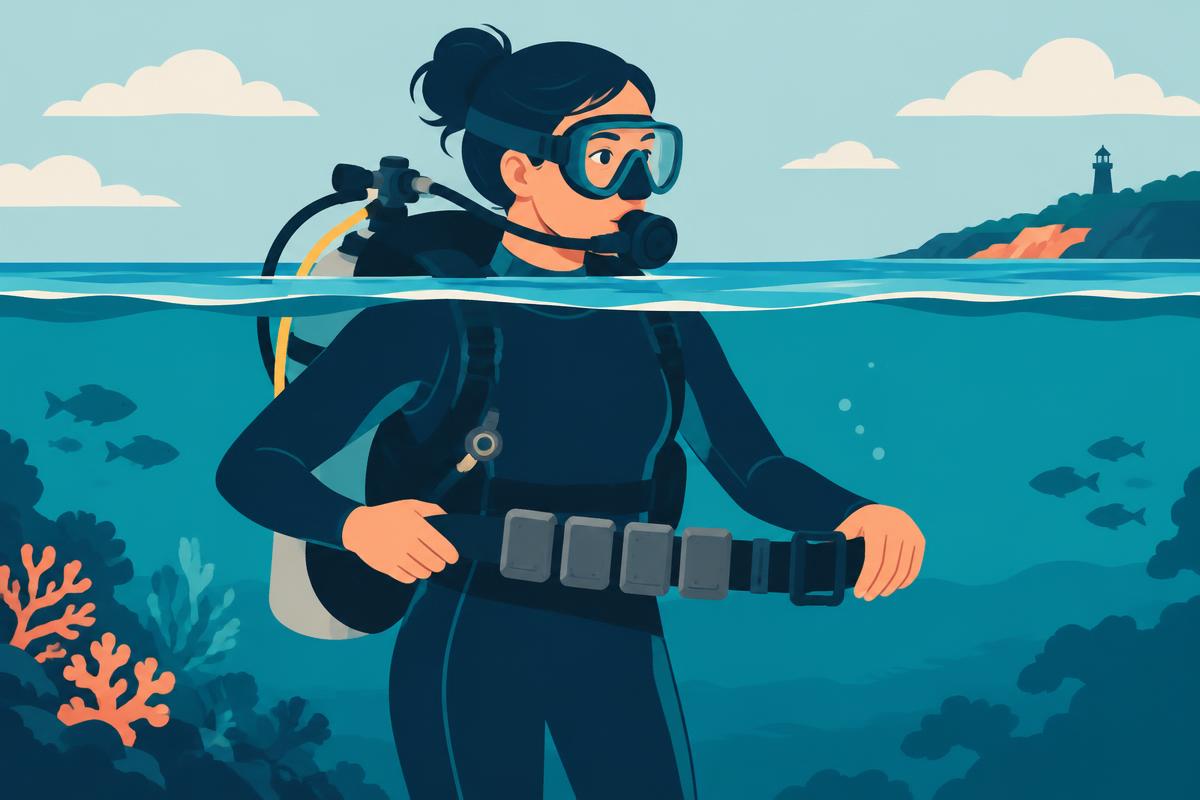
Weighting affects every part of the dive
An overweighted diver works harder and uses gas faster, while an underweighted diver may struggle to maintain a safety stop. Perform a check whenever you change equipment or environment.
When to check your weights
Perform a weight check at the start of every dive trip or when changing any piece of equipment. Even small changes like a new hood or a different cylinder type can significantly alter your buoyancy.
Ideally, conduct the check in shallow water at the start of the dive. If your weights are incorrect, it is much safer to adjust them while you are still near the surface and close to the boat or shore.
The surface check procedure
With your regulator in and a normal breath held, vent all air from your BCD while staying vertical and still. You should float at eye level in the water without using your fins.
When you exhale, you should begin to sink slowly and smoothly. If you sink rapidly while holding a breath, you are likely overweighted and should remove some lead.
Accounting for gas weight
Remember that your cylinder will become lighter as you consume gas during the dive. A standard aluminum cylinder can become significantly more buoyant as it empties.
To account for this, you may need to add a small amount of weight to ensure you remain neutral at your shallow safety stop. Discuss the appropriate compensation for your specific cylinder with an instructor.
Dive-day checklist
Weighting check steps
- Enter shallow water with all equipment on
- Vent all air from the BCD while vertical
- Hold a normal breath and check water level
- Ensure you sink slowly upon exhalation
- Adjust lead until you float at eye level
General guidance only. Follow your training, the dive operator’s procedures, and each manufacturer’s current instructions.
Ask the dive guide
Personal guidance for your next dive
Describe a dive scenario or an equipment-care question. The guide answers in your language and points you to relevant journal articles.
General educational guidance only. It is not medical advice, emergency instruction or a replacement for training, certification, manufacturer instructions, your operator's briefing or your dive plan.