
The working diver’s instrument panel
Before a wrist computer could calculate a dive, working divers relied on a chain of people, gauges, lines and disciplined communication at the surface.
Historic practice is not modern instruction
The equipment and procedures described here belong to their periods and to trained working-diver teams. Historic helmets, gauges and decompression practices are museum subjects, not equipment or techniques for recreational use.
The panel was on the surface
For a helmeted diver supplied from above, the essential instruments were distributed across the operation. A pressure gauge sat by the pump or compressor; depth could be inferred from pressure, sounding or the marked lifeline; elapsed time lived on a watch and in the supervisor’s log. The diver’s ‘display’ was therefore a team rather than a dial on the wrist.
Attendants tended the hose and lifeline, relayed signals and watched the air supply. The supervisor joined these observations into decisions. A reading only became useful when somebody understood its limits, recorded it and acted on it.
Depth, pressure and air
Pressure gauges made the invisible air supply legible, but they did not tell the whole story. Delivery pressure had to overcome the water pressure at the diver’s depth while maintaining flow through long hoses and fittings. Pump rhythm, hose condition and the diver’s reports remained important clues.
Depth measurement also evolved. Pneumofathometers use the pressure required to clear a small open-ended hose to indicate depth. They became a durable surface tool because they gave the supervisor an independent reading close to the diver, provided the line was used and interpreted correctly.
Time becomes a decompression instrument
As knowledge of decompression developed, depth and elapsed time had to be considered together. Tables turned a log of exposure into staged ascent instructions. This was a major change: the panel no longer described only the present condition of the air supply, but informed the route back to the surface.
Tables varied by authority and period. They depended on assumptions, training and accurate inputs. Their history should not be read as permission to reproduce an old schedule; contemporary divers use current procedures, suitable computers and the guidance of their training organisation.
From console to wrist
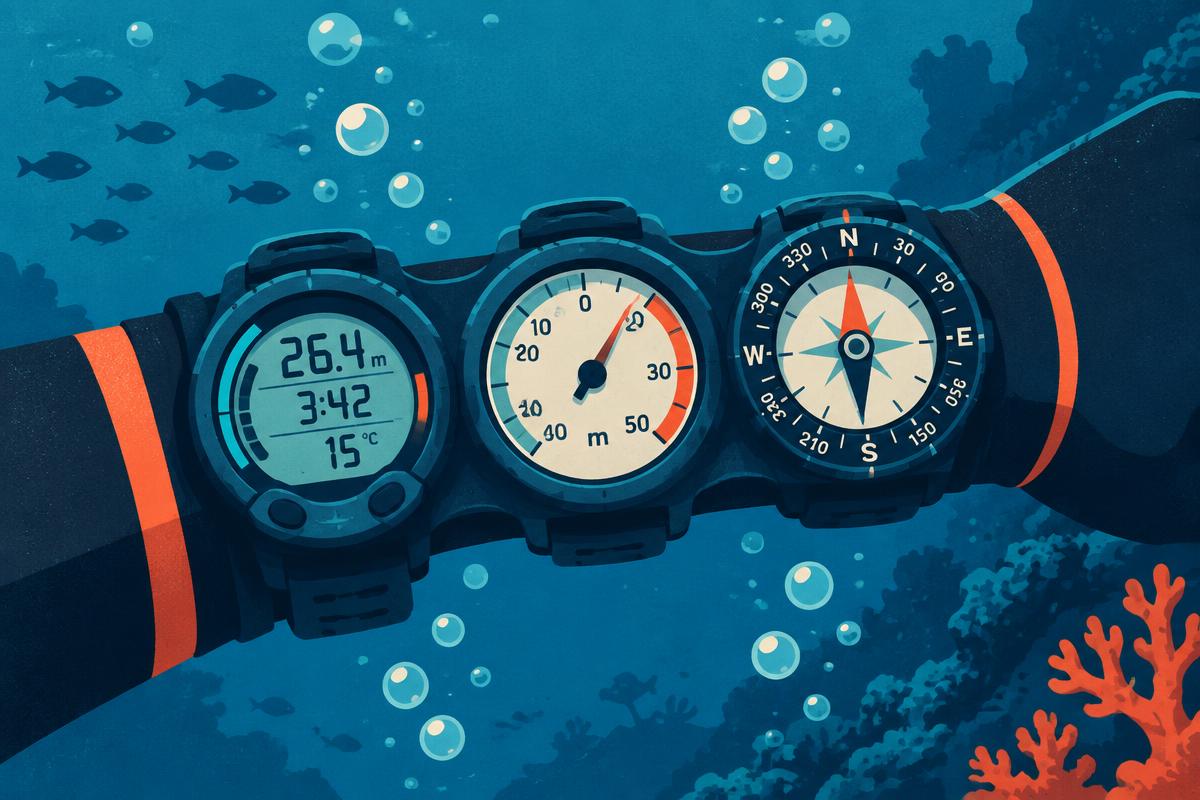
Recreational submersible pressure gauges moved cylinder information into the diver’s own field of view. Mechanical depth gauges and watches followed, then electronic depth-time instruments and decompression computers. Today a single display may combine depth, time, ascent rate, gas pressure, heading and calculated limits.
Integration does not remove judgement. A computer samples and models; it cannot know every detail of workload, thermal stress, illness or a diver’s decisions. Teams still agree limits, compare information and carry an appropriate way to monitor the dive if one display fails.
Reading instruments well
Good display design makes urgent information distinct and leaves secondary detail available without clutter. The best panel is not necessarily the one with the most numbers. It is the one a trained diver can interpret correctly in low visibility, thick gloves and rising task load.
Set the computer before entering the water, know its alarms and screen sequence, and do not swap it between divers during an active series of dives. Read the manual rather than relying on familiarity with another model. The working diver’s old lesson remains useful: instruments support a plan, a team and a written record.
Dive-day checklist
A modern instrument check
- Set gas, conservatism and display mode before the dive
- Confirm battery, time, depth and pressure indications
- Agree limits and signals with the buddy team
- Know how the display reports ascent rate and stops
- Log the dive and investigate inconsistent readings
General guidance only. Follow your training, the dive operator’s procedures, and each manufacturer’s current instructions.
Ask the dive guide
Personal guidance for your next dive
Describe a dive scenario or an equipment-care question. The guide answers in your language and points you to relevant journal articles.
General educational guidance only. It is not medical advice, emergency instruction or a replacement for training, certification, manufacturer instructions, your operator's briefing or your dive plan.